




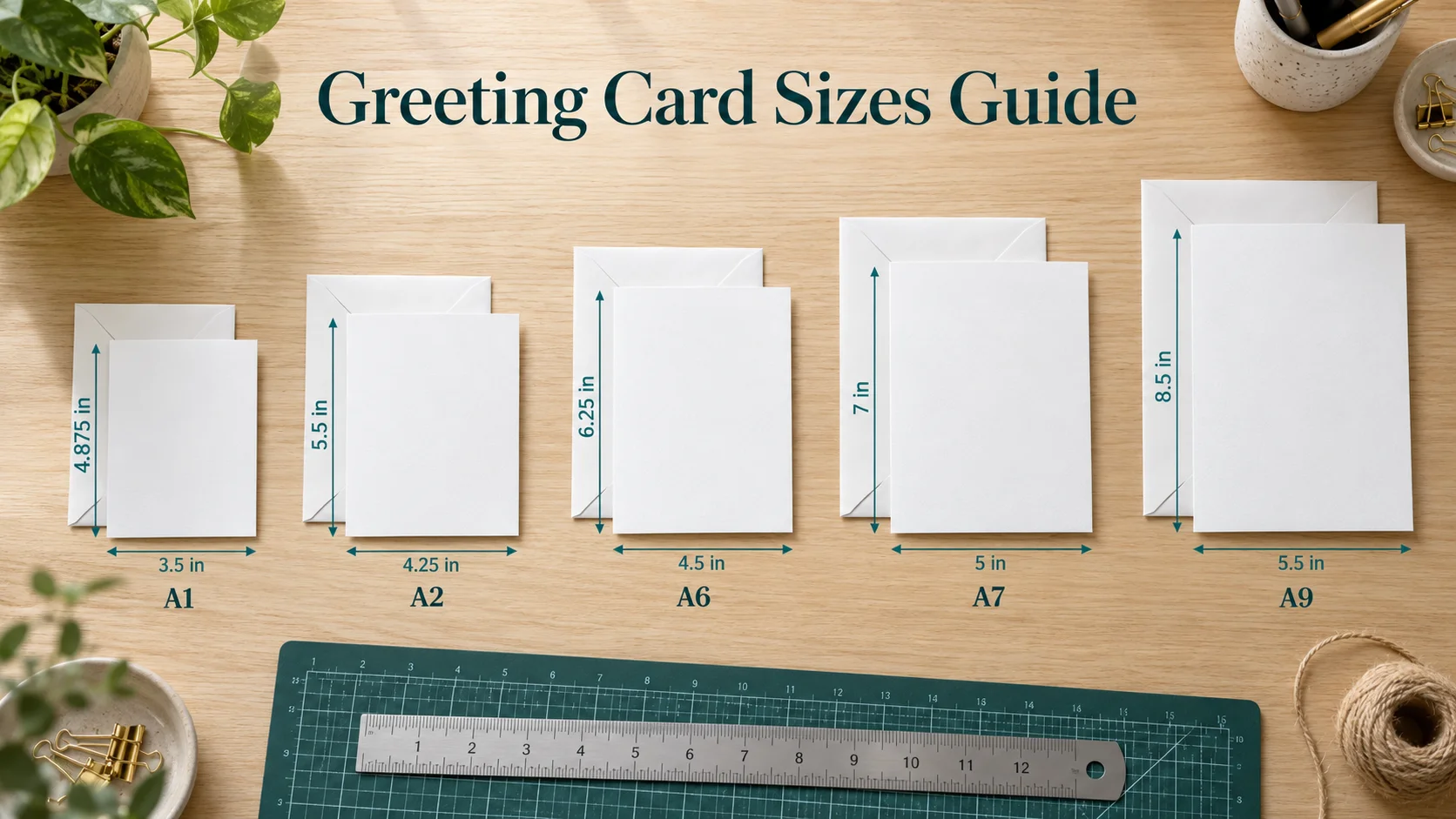
The most common standard greeting card size in the US is 5 × 7 inches (A7), which fits a 5.25 × 7.25-inch A7 envelope. The second most popular is 4.25 × 5.5 inches (A2), used for thank-you notes and boxed card sets. Outside North America, the usual sizes are A6 (105 × 148 mm) and A5 (148 × 210 mm).
Do you run a stationery brand, sell printable art on Etsy, or just want your birthday card to fit the envelope? Then card size matters more than it seems. The wrong size can mean a card that rattles around in its envelope, a design cropped at the edge, or a postage bill twice what you budgeted.
This guide brings every greeting card dimension into one place: the US A-series and the international ISO sizes, folded and flat measurements, matching envelopes, birthday, Christmas and thank-you card sizes, print-file setup, and the 2026 postal rules that decide what a card costs to mail.
What Size Is a Standard Greeting Card?
There isn’t one legal “standard.” The industry has settled on a few common sizes, and what counts as standard depends on where you are.
- United States & Canada: The 5 × 7 inch (A7) card is the most common greeting card size. Most birthday, holiday, sympathy and photo cards in stores use it. The A2 (4.25 × 5.5 inches) comes second and is the usual size for thank-you notes and boxed sets.
- UK, Europe, Asia and Australia: Cards follow ISO 216 paper sizes. A6 (105 × 148 mm) is the everyday card, A5 (148 × 210 mm) is the larger premium card, and square cards of 145–150 mm are very popular for birthdays and Christmas.
Size is usually quoted as the folded size, meaning the front cover you see on the shelf. A 5 × 7 card is printed on a 10 × 7 inch sheet and then folded in half.
So how big is a standard greeting card? Roughly the size of an adult’s open hand: about 13 × 18 cm in the US and 10.5 × 15 cm in Europe.
Greeting Card Size Chart (Inches, cm, mm)
This greeting card size chart covers the folded size, the flat print size, and the matching envelope for every common format.
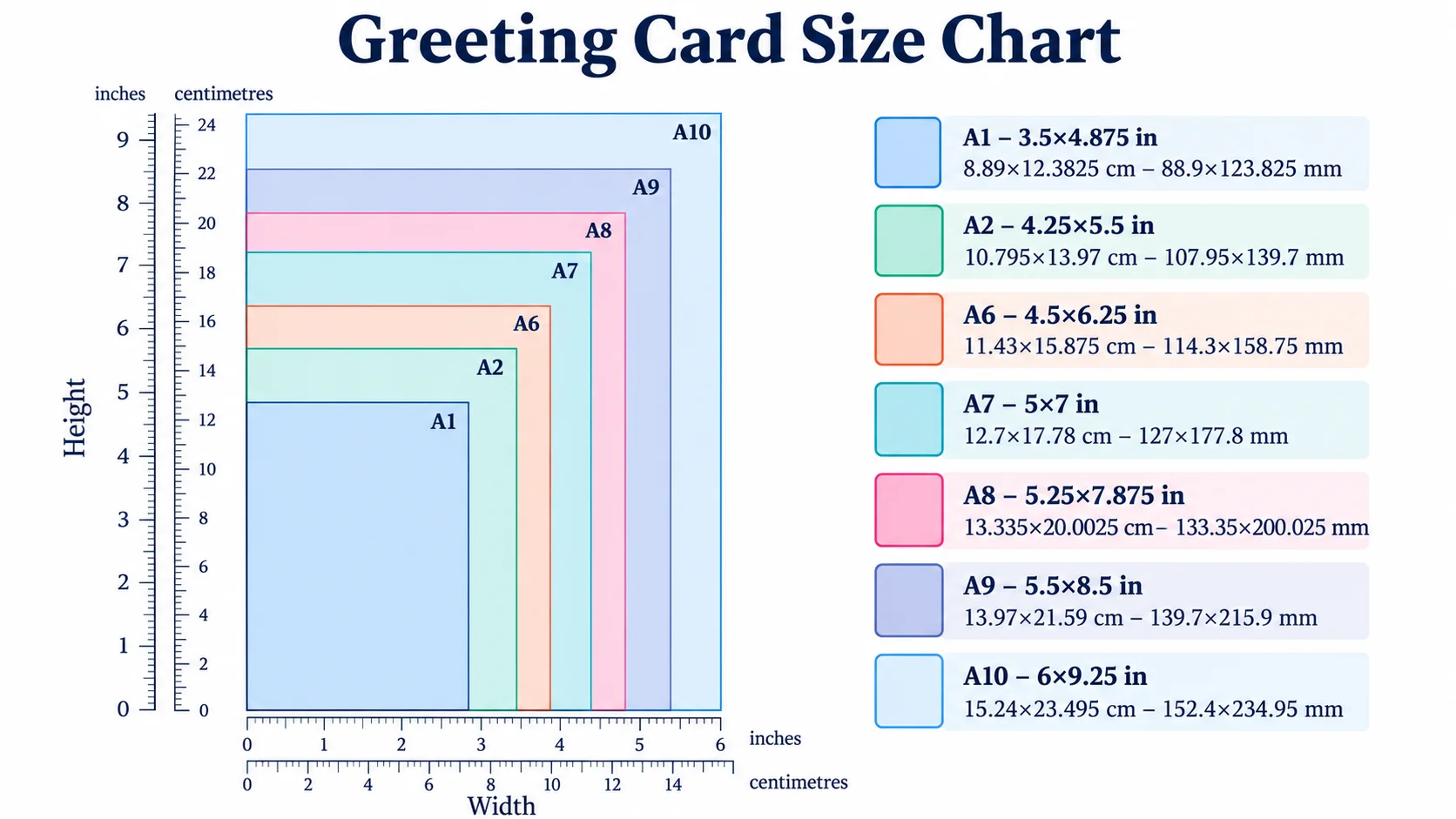
US A-Series Greeting Card Sizes
| Card Size | Folded (in) | Folded (cm) | Folded (mm) | Flat (in) | Envelope (in) | Best For |
|---|---|---|---|---|---|---|
| A1 (4-Bar) | 3.5 × 4.875 | 8.9 × 12.4 | 89 × 124 | 7 × 4.875 | 3.625 × 5.125 | RSVPs, gift enclosures |
| A2 | 4.25 × 5.5 | 10.8 × 14.0 | 108 × 140 | 8.5 × 5.5 | 4.375 × 5.75 | Thank-you notes, boxed sets |
| A6 | 4.5 × 6.25 | 11.4 × 15.9 | 114 × 159 | 9 × 6.25 | 4.75 × 6.5 | Invitations, photo cards |
| A7 | 5 × 7 | 12.7 × 17.8 | 127 × 178 | 10 × 7 | 5.25 × 7.25 | Birthday, Christmas, wedding |
| A8 | 5.25 × 7.875 | 13.3 × 20.0 | 133 × 200 | 10.5 × 7.875 | 5.5 × 8.125 | Premium invitations |
| A9 | 5.5 × 8.5 | 14.0 × 21.6 | 140 × 216 | 11 × 8.5 | 5.75 × 8.75 | Corporate holiday cards |
| A10 | 6 × 9.25 (approx.) | 15.2 × 23.5 | 152 × 235 | 12 × 9.25 | 6 × 9.5 | Oversized, tall cards |
International (ISO) Greeting Card Sizes
| Card Size | Folded (mm) | Folded (cm) | Folded (in) | Flat Sheet | Envelope | Best For |
|---|---|---|---|---|---|---|
| A7 (ISO) | 74 × 105 | 7.4 × 10.5 | 2.9 × 4.1 | A6 | C7 (81 × 114 mm) | Gift tags, mini cards |
| A6 | 105 × 148 | 10.5 × 14.8 | 4.1 × 5.8 | A5 | C6 (114 × 162 mm) | Everyday greeting cards |
| A5 | 148 × 210 | 14.8 × 21.0 | 5.8 × 8.3 | A4 | C5 (162 × 229 mm) | Premium birthday & Christmas |
| DL | 99 × 210 | 9.9 × 21.0 | 3.9 × 8.3 | 198 × 210 mm | DL (110 × 220 mm) | Invitations, slim cards |
| Small Square | 100–145 sq. | 10–14.5 sq. | 3.9–5.7 sq. | 2× width | 155 × 155 mm | Mini & modern cards |
| Large Square | 150 × 150 | 15 × 15 | 5.9 × 5.9 | 300 × 150 mm | 160 × 160 mm | Christmas & art cards |
Pro tip: Keep the cm table handy if you work across markets. Search terms like ukuran card ucapan and size kartu ucapan (Indonesian for “greeting card size”) almost always point to these same ISO sizes: A6 (10.5 × 14.8 cm) and A5 (14.8 × 21 cm).
US “A” Sizes vs. International “A” Sizes: Why They Get Confused
This mix-up causes more misprints than any other. The letter “A” means two different systems.
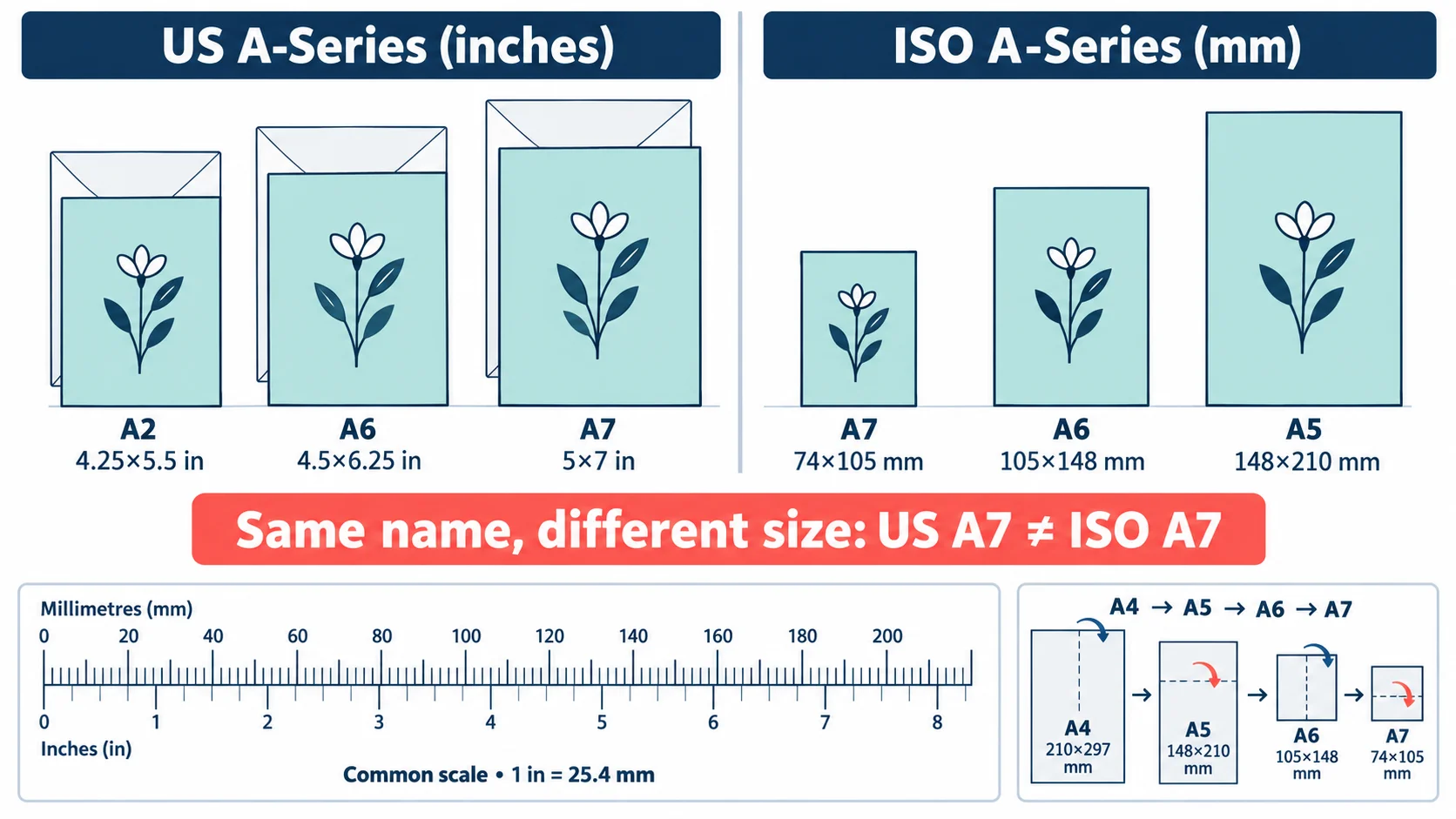
| Name | US A-Series (envelope-based) | ISO A-Series (paper-based) |
|---|---|---|
| A2 | 4.25 × 5.5 in (card) | 420 × 594 mm (poster!) |
| A6 | 4.5 × 6.25 in (card) | 105 × 148 mm (card) |
| A7 | 5 × 7 in (card) | 74 × 105 mm (mini card) |
- US A-sizes come from the North American announcement envelope system. The number names the envelope, and the card is cut slightly smaller to fit inside.
- ISO A-sizes come from the metric paper standard ISO 216, where each size is exactly half of the one before it (A4 → A5 → A6).
So a US “A7 card” is a 5 × 7 inch birthday card, while an ISO A7 is a tiny 7.4 × 10.5 cm gift tag. If you order “A7” from a European printer expecting 5 × 7, you’ll get a card about the size of a playing card. Always check the measurements, not just the name.
Folded Size vs. Flat Size
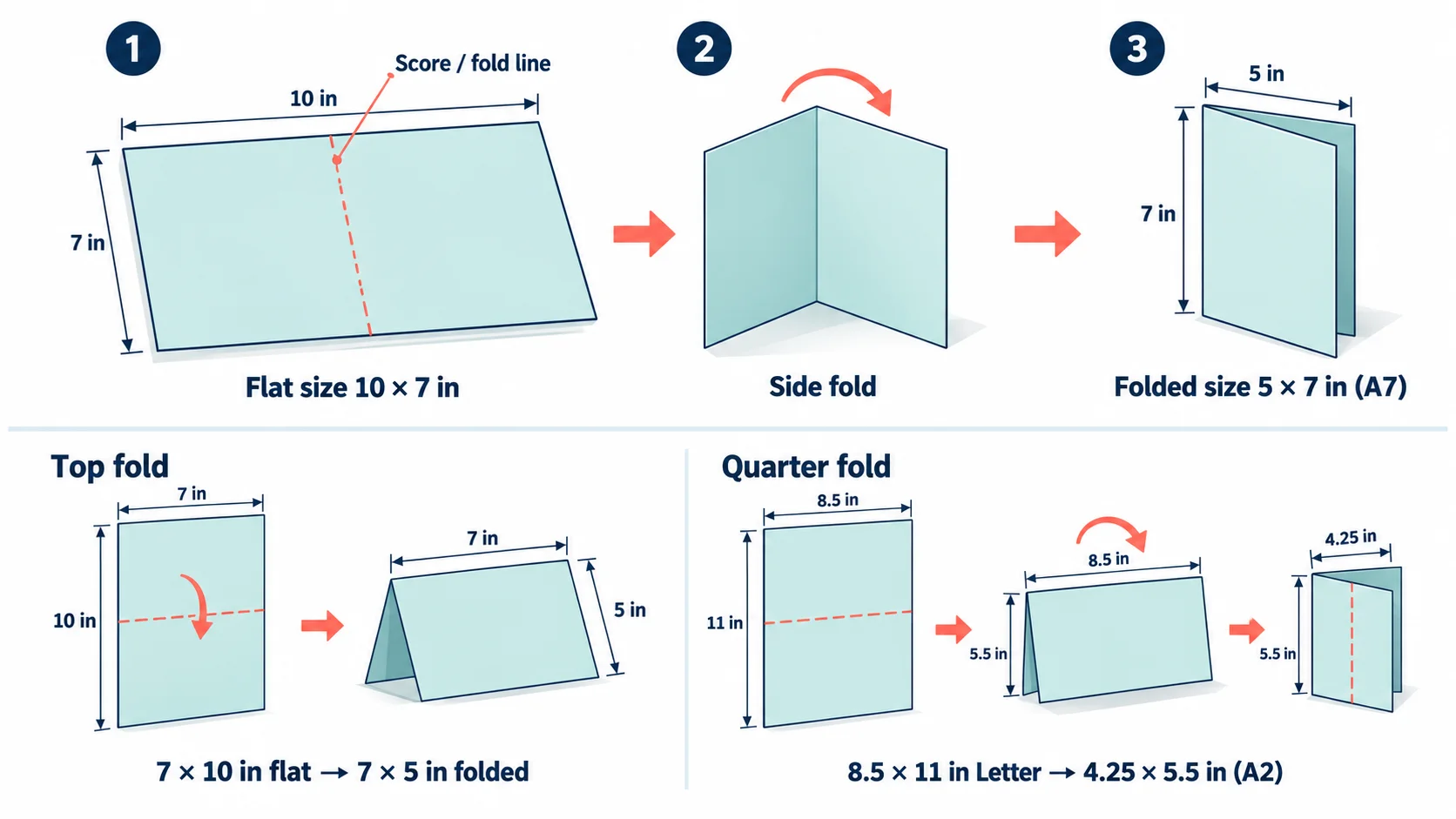
- Folded (finished) size: The size of the card once closed. Shops, envelopes and size charts all use this number.
- Flat (unfolded) size: The size of the printed sheet before it’s scored and folded. Your design file is built at this size.
How to Work Out the Flat Size
- Side-fold (book-style) card: double the width → 5 × 7 folded = 10 × 7 flat
- Top-fold (tent) card: double the height → 7 × 5 folded = 7 × 10 flat
- Quarter-fold card: one US Letter sheet (8.5 × 11 in) folded twice = A2 (4.25 × 5.5 in). This is why A2 is so common on home printers.
Common Folded Card Sizes at a Glance
| Folded Size | Flat Sheet | Sheets Per Letter / A4 |
|---|---|---|
| 4.25 × 5.5 in (A2) | 8.5 × 5.5 in | 2 per Letter sheet |
| 5 × 7 in (A7) | 10 × 7 in | 1 per Letter sheet (with trim) |
| 5.5 × 8.5 in (A9) | 11 × 8.5 in | 1 full Letter sheet |
| 105 × 148 mm (A6) | 210 × 148 mm (A5) | 2 per A4 sheet |
| 148 × 210 mm (A5) | 297 × 210 mm (A4) | 1 full A4 sheet |
Standard Birthday Card Size
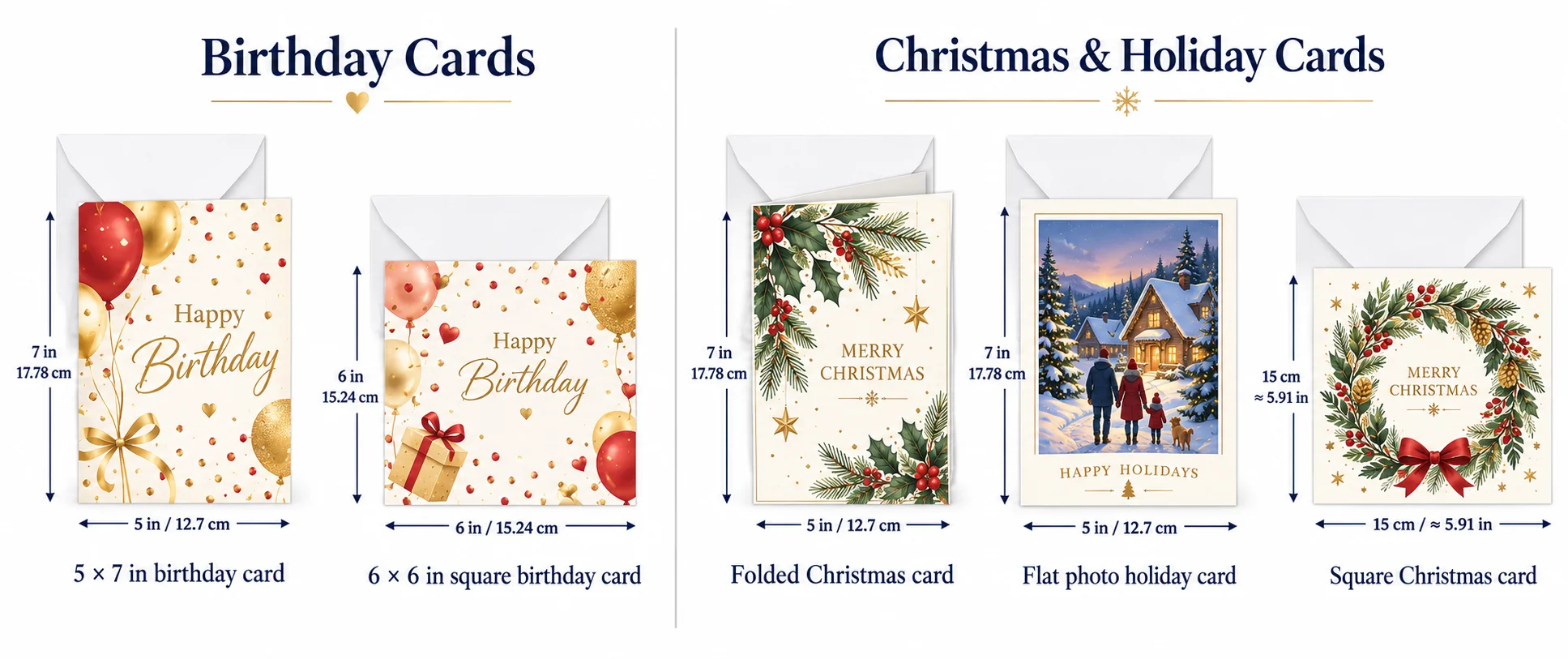
What size is a standard birthday card? In the US, the standard birthday card size is 5 × 7 inches (A7). That’s 12.7 × 17.8 cm, mailed in a 5.25 × 7.25 inch envelope. In the UK and Europe, the most common birthday card dimensions are A6 (10.5 × 14.8 cm), A5 (14.8 × 21 cm) and square 15 × 15 cm.
| Birthday Card Type | Size (inches) | Size (cm) | Why People Choose It |
|---|---|---|---|
| Standard (US) | 5 × 7 | 12.7 × 17.8 | Most popular, room for art and a message |
| Small | 4.25 × 5.5 | 10.8 × 14.0 | Gift enclosures, kids’ cards, budget sets |
| Mid-size | 4.5 × 6.25 | 11.4 × 15.9 | Photo birthday cards |
| Large | 5.5 × 8.5 | 14.0 × 21.6 | Milestone birthdays (18th, 50th) |
| Square | 5 × 5 or 6 × 6 | 12.7 or 15.2 sq. | Modern, artistic designs (extra US postage) |
| Jumbo / Giant | 8.5 × 11 and up | 21.6 × 27.9 + | Group signing, office cards (hand-delivered) |
How big are birthday cards on average? Most retail birthday cards fall between A2 and A7, so the average birthday card size is roughly 5 × 7 inches. In the UK, the average is closer to A6 or a 150 mm square.
Christmas & Holiday Card Size
Standard Christmas card size (US): 5 × 7 inches, folded or as a flat photo card. A family photo printed at 5 × 7 is the classic holiday card.
Typical Christmas card size (UK / Europe): A6 (10.5 × 14.8 cm), 5 × 7 inches, or square 15 × 15 cm. Charity multipacks usually use small square or A6 cards.
| Holiday Card Format | Dimensions | Envelope | Notes |
|---|---|---|---|
| Folded 5 × 7 | 5 × 7 in / 12.7 × 17.8 cm | A7 (5.25 × 7.25 in) | Most common Christmas card size |
| Flat photo card | 5 × 7 in | A7 | Cheaper to print, one heavy panel |
| A2 holiday note | 4.25 × 5.5 in | A2 | Boxed corporate sets |
| A6 holiday card | 10.5 × 14.8 cm | C6 | UK & EU standard |
| Square Christmas card | 5 × 5 in / 15 × 15 cm | 5.5 in / 160 mm sq. | Stylish, but costs extra US postage |
| Corporate card | 5.5 × 8.5 in (A9) | A9 | Space for logo and team signatures |
| Flat postcard | 4 × 6 in | None | Mails at the lower postcard rate |
Average Christmas card dimensions: about 5 × 7 inches (12.7 × 17.8 cm). Order holiday cards and envelopes together. Envelope stock in December runs out fast, and a mismatched white is easy to spot.
Thank-You Card & Note Card Size
Standard thank-you card size: A2 (4.25 × 5.5 inches / 10.8 × 14 cm). It’s big enough for three or four handwritten sentences and small enough to send in bulk after a wedding or event. In cm, a thank-you card is usually 10.8 × 14 cm (A2) or 10.5 × 14.8 cm (A6 ISO).
| Card | Dimensions | Typical Use |
|---|---|---|
| A1 / 4-Bar | 3.5 × 4.875 in | Gift tags, RSVP replies |
| 3 × 5 Index | 3 × 5 in | Quick notes, recipes, study cards |
| A2 | 4.25 × 5.5 in | Thank-you cards, personal stationery |
| 4 × 6 Flat | 4 × 6 in | Flat thank-you notes, announcements |
| A6 | 4.5 × 6.25 in | Larger thank-you notes, invitations |
| A7 | 5 × 7 in | Formal thank-you cards, wedding stationery |
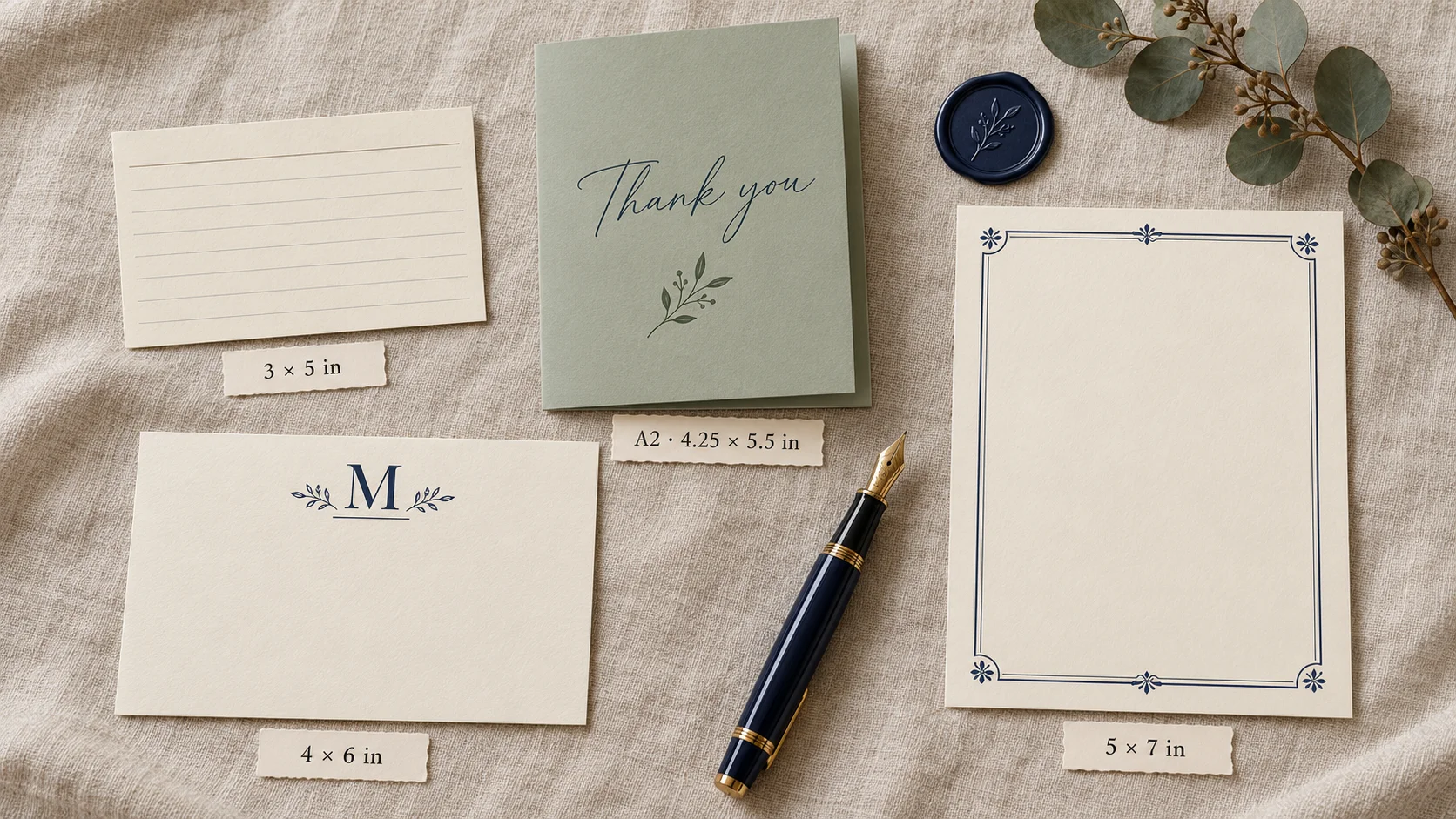
Flat vs. folded note cards: A flat note card is one heavy panel, often with a monogram at the top. A folded note card gives you a decorated front and an inside writing space. Both use A2 envelopes at the A2 size.
Square, Small and Specialty Card Sizes
Square Cards
5 × 5, 5.5 × 5.5, 6 × 6 in or 145/150 mm. They look modern and suit artwork, but cost extra to mail in the US.
Small Greeting Cards
A1 (3.5 × 4.875 in), mini 3 × 4 in, ISO A7 (7.4 × 10.5 cm). Used as gift enclosures, florist cards and tags.
Slimline / No. 10
3.875 × 8.875 in to 4 × 9.25 in. Used for elegant invitations and money-holder cards.
Panoramic / DL
4 × 8 in and DL (99 × 210 mm). Long formats for landscapes, menus and invitations.
- Postcard rate: 3.5 × 5 to 4.25 × 6 in
- 4 × 6 card mails at the postcard rate
- 5 × 7 flat card pays the letter rate
- Postcard thickness: 0.007–0.016 in
Other Card Sizes People Confuse With Greeting Cards
| Card | Standard Size (in) | Standard Size (mm) |
|---|---|---|
| Gift card (CR80) | 3.375 × 2.125 | 85.6 × 54 |
| Business card (US) | 3.5 × 2 | 89 × 51 |
| Playing / trading card | 2.5 × 3.5 | 63.5 × 88.9 |
| Postcard (US standard) | 4 × 6 | 102 × 152 |
So how big is a gift card in inches? A standard plastic gift card is 3.375 × 2.125 inches, the same as a credit card. Gift card holders or carrier cards are usually printed at about 3.5 × 6 or A2 size so they fit a greeting card envelope.
Standard Greeting Card Envelope Sizes
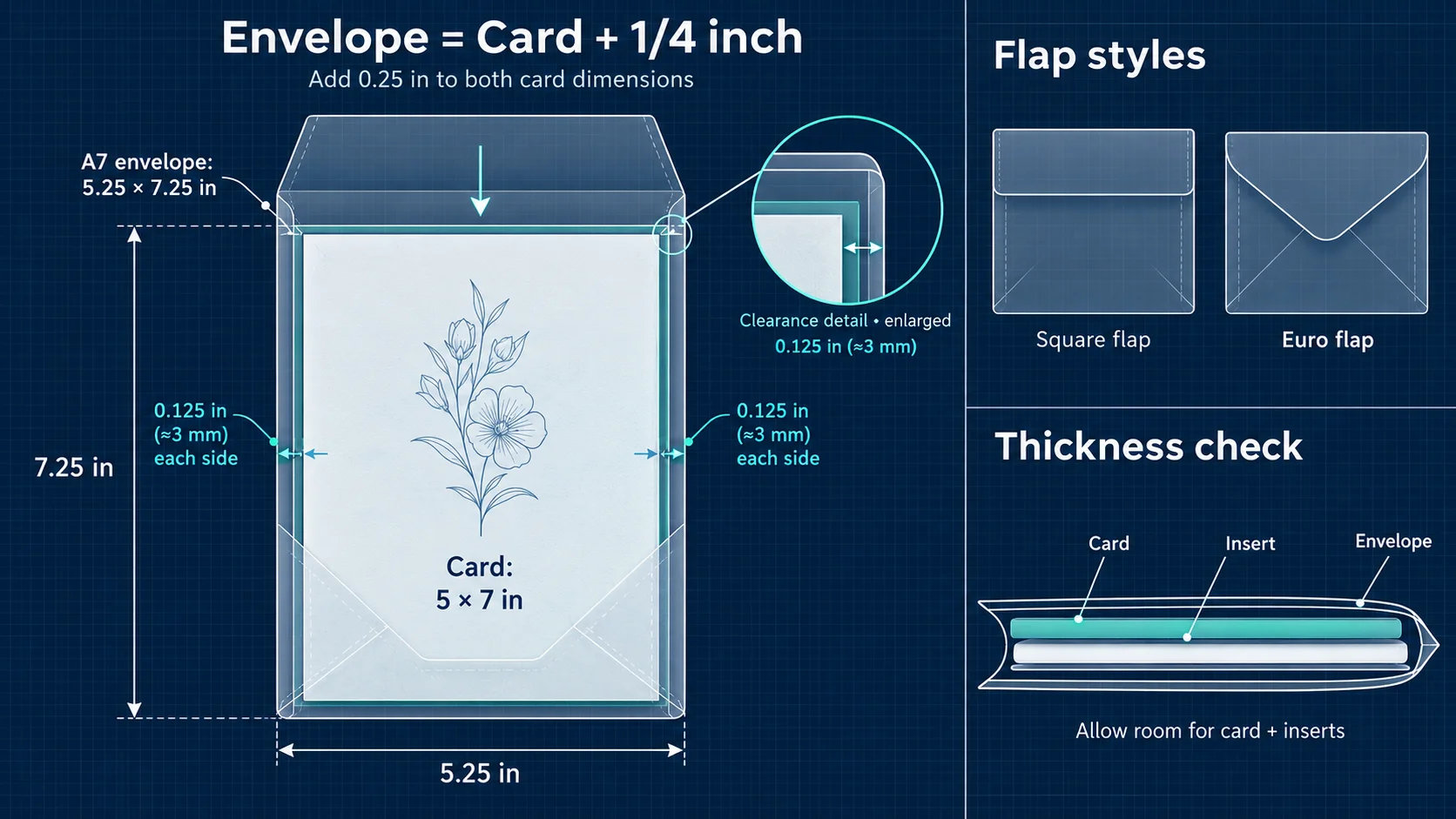
Rule of thumb: an envelope should be about 0.125 in (3 mm) larger on each side, or 0.25 in (6 mm) larger overall, than the card. That leaves enough room to slide the card in without bending its corners, but not so much that it moves around in the post.
| Envelope | Size (in) | Size (mm) | Fits Card Size |
|---|---|---|---|
| A1 (4-Bar) | 3.625 × 5.125 | 92 × 130 | 3.5 × 4.875 in |
| A2 | 4.375 × 5.75 | 111 × 146 | 4.25 × 5.5 in |
| A6 | 4.75 × 6.5 | 121 × 165 | 4.5 × 6.25 in |
| A7 | 5.25 × 7.25 | 133 × 184 | 5 × 7 in |
| A8 | 5.5 × 8.125 | 140 × 206 | 5.25 × 7.875 in |
| A9 | 5.75 × 8.75 | 146 × 222 | 5.5 × 8.5 in |
| A10 | 6 × 9.5 | 152 × 241 | 5.75–6 × 9.25 in |
| Square 5.5 | 5.5 × 5.5 | 140 × 140 | 5 × 5 in |
| Square 6.5 | 6.5 × 6.5 | 165 × 165 | 6 × 6 in |
| C6 (ISO) | 4.5 × 6.4 | 114 × 162 | A6 card |
| C5 (ISO) | 6.4 × 9 | 162 × 229 | A5 card |
| DL (ISO) | 4.3 × 8.7 | 110 × 220 | DL card / A4 folded in three |
Inserts and embellishments: If you add a vellum wrap, a ribbon, a photo, or a gift card, check the total thickness. Even a few millimetres more can make an envelope bulge, tear at the flap, or get classed as nonmachinable.
Mailing Rules: When Card Size Costs You Extra Postage
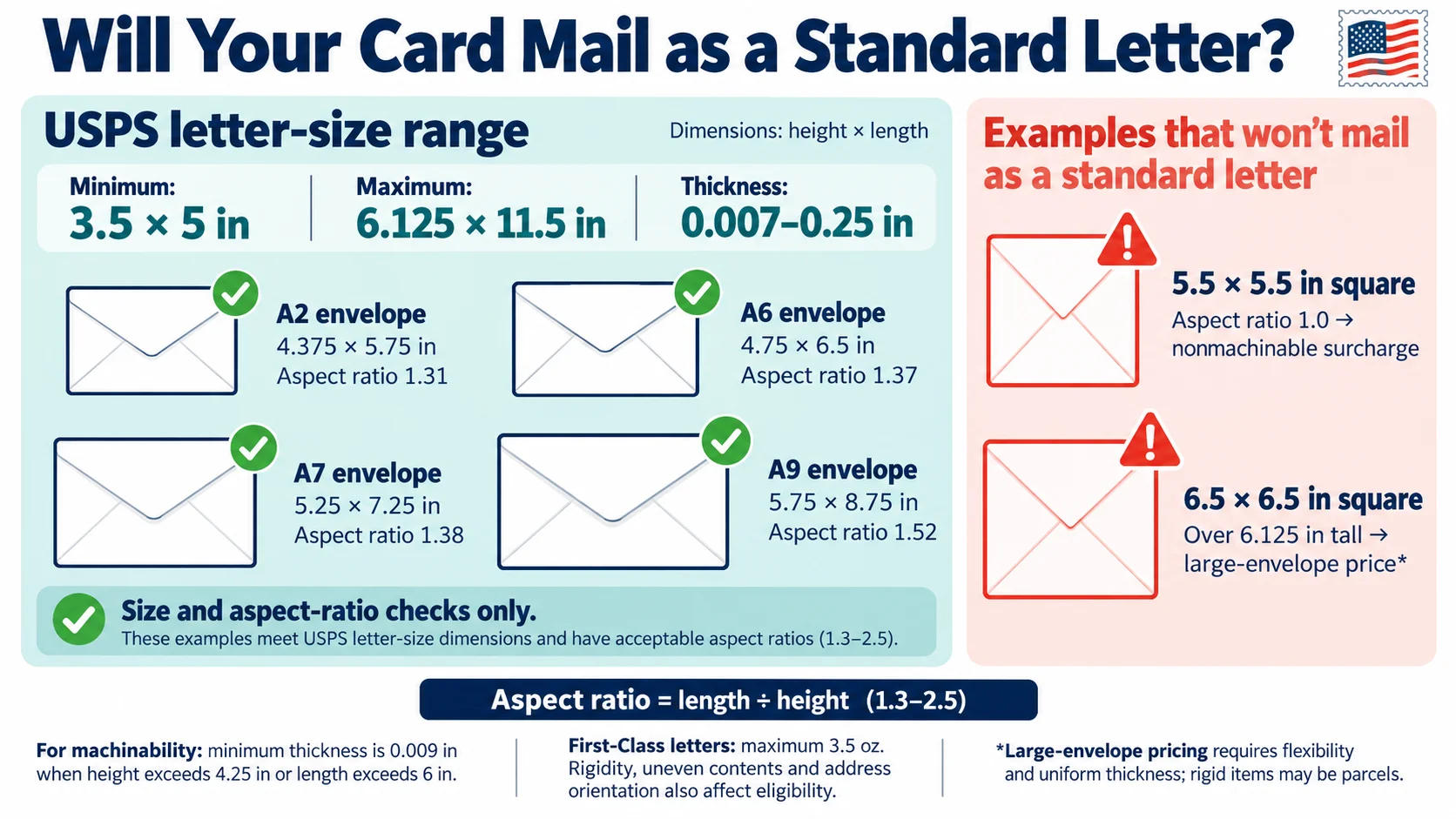
To the post office, your card is a letter. To mail at the normal First-Class letter price, a US envelope must meet these USPS letter standards:
| Requirement | Minimum | Maximum |
|---|---|---|
| Height | 3.5 in | 6.125 in |
| Length | 5 in | 11.5 in |
| Thickness | 0.007 in | 0.25 in |
| Weight | n/a | 3.5 oz |
| Aspect ratio (length ÷ height) | 1.3 | 2.5 |
What That Means for Greeting Cards
- A2, A6, A7 and A9 envelopes all pass. Their aspect ratios fall between 1.31 and 1.52, and they mail with one Forever stamp ($0.82 since July 12, 2026) if they weigh 1 oz or less.
- Square envelopes fail the aspect-ratio test (ratio 1.0). They’re nonmachinable and need an extra nonmachinable surcharge on top of the stamp.
- A 6.5 × 6.5 inch square envelope is taller than 6.125 inches, so USPS prices it as a large envelope (flat), which costs much more than a letter.
- Heavy, lumpy or rigid cards (wax seals, buttons, wooden cards) are also nonmachinable, even if their size is fine.
- Each extra ounce adds about $0.29. A thick card with a photo insert can easily pass 1 oz.
Outside the US: Royal Mail (UK) prices a “Letter” up to 240 × 165 × 5 mm and 100 g, so A6 and A5 cards in C6/C5 envelopes both go as standard letters. Thick cards over 5 mm become “Large Letters” and cost more.
Note: Postage prices change often. Check the current USPS Notice 123 or your national postal service’s price list before a large mailing.
How to Set Up a Greeting Card Print File
Sellers lose the most money here. A great design in the wrong file setup prints with white slivers or cropped text.
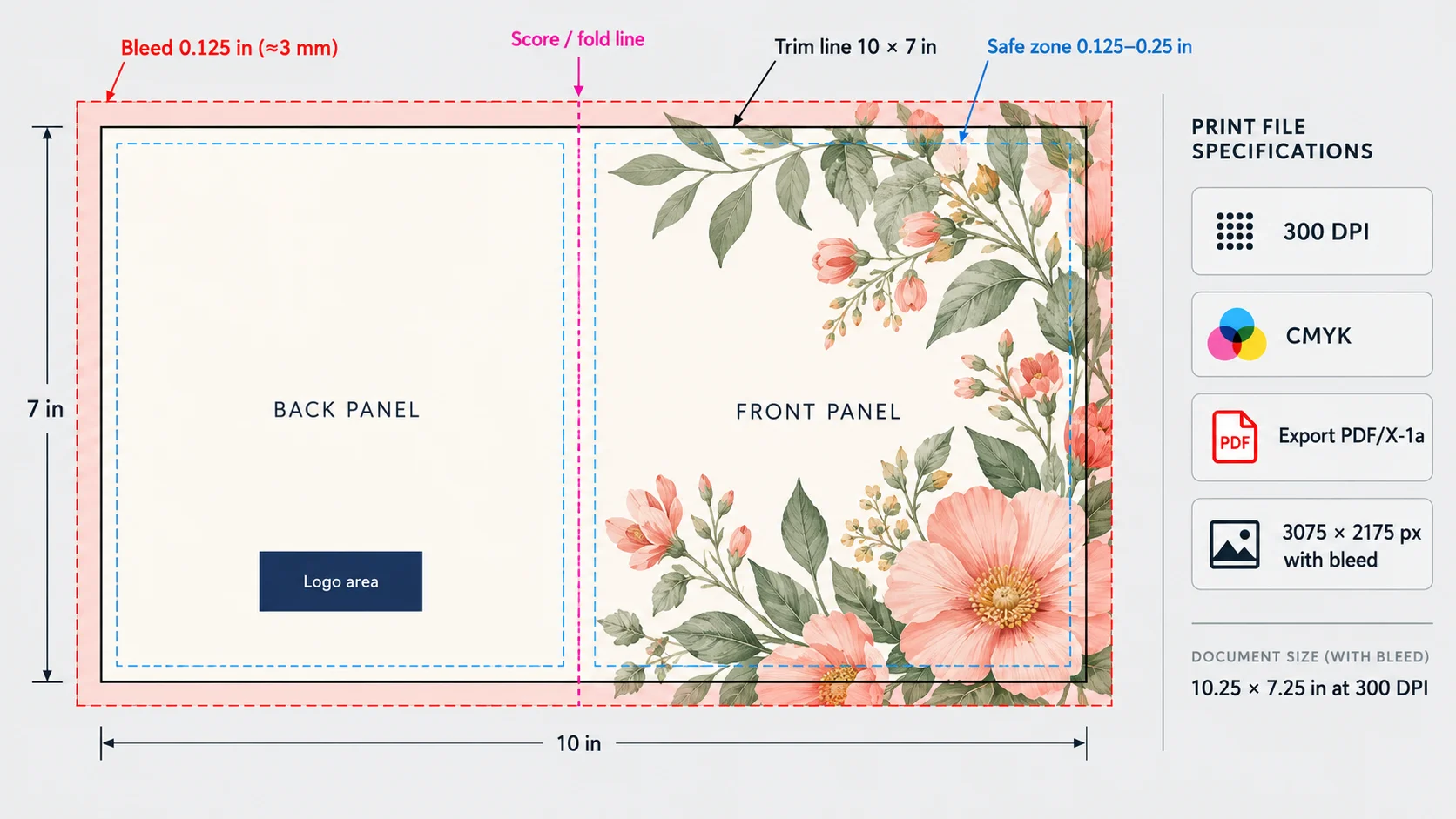
- Build at the flat size: For a 5 × 7 folded card, set your artboard to 10 × 7 inches.
- Add bleed: Extend background colors and images 0.125 in (3 mm) past every trim edge. Your 10 × 7 file becomes 10.25 × 7.25 inches with bleed.
- Keep a safe zone: Keep text, faces and logos at least 0.125–0.25 in (3–6 mm) inside the trim line, and away from the fold.
- Mark the score line: Put a non-printing guide where the fold goes. Avoid thin lines or text running straight along the fold, because cardstock can crack there.
- Resolution: Use 300 DPI at final size. A 5 × 7 front panel is 1500 × 2100 px, and a 10 × 7 flat sheet is 3000 × 2100 px.
- Color mode: Use CMYK for offset and most digital printers. Embed fonts or convert them to outlines, and export as PDF/X-1a or PDF/X-4.
Pixel Dimensions at 300 DPI (Folded Front)
| Card | Pixels (no bleed) | Pixels (with 0.125″ bleed) |
|---|---|---|
| A2 – 4.25 × 5.5 in | 1275 × 1650 | 1350 × 1725 |
| A6 – 4.5 × 6.25 in | 1350 × 1875 | 1425 × 1950 |
| A7 – 5 × 7 in | 1500 × 2100 | 1575 × 2175 |
| A9 – 5.5 × 8.5 in | 1650 × 2550 | 1725 × 2625 |
| ISO A6 – 105 × 148 mm | 1240 × 1748 | 1311 × 1819 |
| ISO A5 – 148 × 210 mm | 1748 × 2480 | 1819 × 2551 |
Greeting Card Paper Weight and Fold Types
Size and paper weight work together. A 5 × 7 card on thin paper feels cheap, while an A2 card on 130 lb cover feels premium.
Recommended Cardstock for Greeting Cards
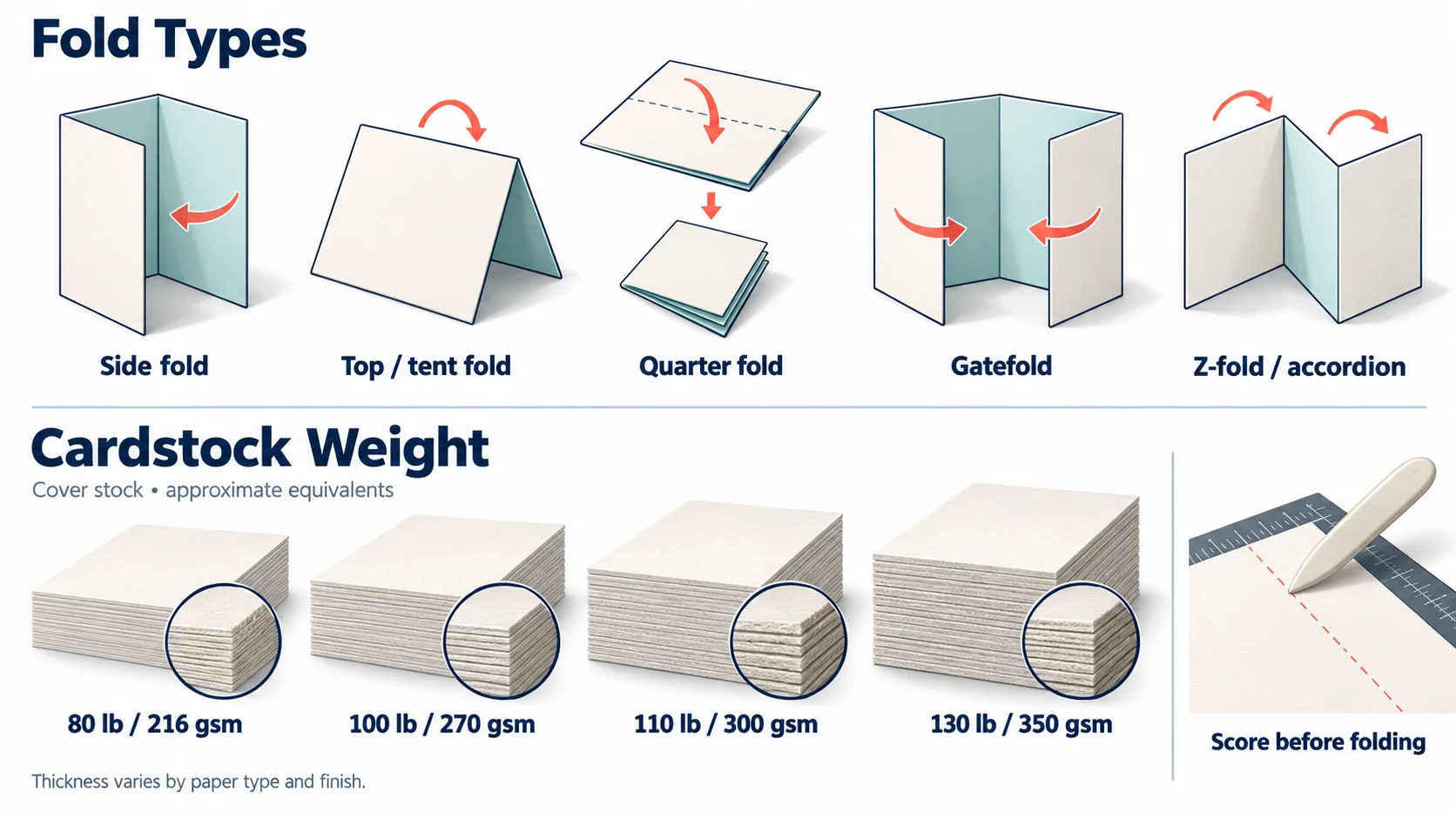
| Weight (US) | Approx. GSM | Feel | Best For |
|---|---|---|---|
| 80 lb cover | ~216 gsm | Light and flexible | Home printing, inserts |
| 100 lb cover | ~270 gsm | Sturdy | Standard retail cards |
| 110 lb cover | ~300 gsm | Thick | Premium birthday & holiday cards |
| 130 lb cover | ~350 gsm | Very thick, luxurious | Wedding stationery, boutique cards |
Fold Types
- Side fold (book fold): The card opens like a book. This is the most common.
- Top fold (tent fold): The card opens upward and works well for landscape artwork.
- Quarter fold: One sheet folded twice. It’s cheap and easy on home printers (makes A2 from Letter).
- Gatefold: Two flaps open from the center. Used for wedding and luxury holiday cards.
- Z-fold / accordion: Used for photo stories and multi-panel art.
Printing Tips
- Score before folding any stock heavier than about 80 lb cover. Otherwise the fibers crack.
- Fold with the grain. Paper grain should run parallel to the fold for a clean, flat card.
- Finishes (matte, gloss, soft-touch, foil, emboss) don’t change the size, but foil and emboss add a little thickness and can push a card over the mailing limit.
Make Your Cards Stand Out on the Shelf
Premium card boxes, window packaging and sleeves with foil, emboss and spot UV, made to your card size.
E-Card and Digital Greeting Card Sizes
If you sell printable or digital cards, size in pixels for the screen they’ll be viewed on:
| Use | Recommended Size |
|---|---|
| Email e-card | 600–800 px wide (keep the file under 1 MB) |
| Instagram / WhatsApp square | 1080 × 1080 px |
| Instagram portrait | 1080 × 1350 px |
| Stories / mobile full screen | 1080 × 1920 px |
| Printable 5 × 7 (digital download) | 1500 × 2100 px at 300 DPI |
| Printable A6 | 1240 × 1748 px at 300 DPI |
Tip for Etsy sellers: Offer two files: a 5 × 7 inch version for US buyers and an A6/A5 version for UK and EU buyers. Most “the card didn’t fit” complaints come from mixing up these two systems.
How to Choose the Right Greeting Card Size
Ask yourself these five questions:
- Where will it be sold or sent? US buyers expect 5 × 7 or A2. UK and EU buyers expect A6, A5 or square.
- How much needs to be written? A short thank-you fits A2. Photos, poems or group signatures need A7 or A9.
- Will it be mailed? Choose a rectangular A-series envelope to stay under the letter rate. Use square cards only if you’re happy to pay the surcharge or hand-deliver.
- What paper and printer do you have? Home printers handle A2 (quarter-fold or two per sheet) and A7 easily. A9 uses a whole Letter sheet.
- What does your packaging look like? Retail cello sleeves, display racks and custom card boxes are all made to set sizes. Choose your card size first, then size the packaging around it.
Quick Picks
- Best all-round card: 5 × 7 (A7)
- Best for thank-you cards and boxed sets: 4.25 × 5.5 (A2)
- Best for UK/EU retail: A6 or 150 mm square
- Best for corporate holiday cards: 5.5 × 8.5 (A9)
- Cheapest to mail: 4 × 6 flat postcard
Greeting Card Size FAQs
What is the standard greeting card size?
In the US, the standard greeting card size is 5 × 7 inches (12.7 × 17.8 cm), known as A7. Outside North America, the standard is A6 (10.5 × 14.8 cm).
What size is a standard birthday card?
A standard birthday card is 5 × 7 inches folded and fits a 5.25 × 7.25-inch A7 envelope. In the UK, A6, A5 and 15 cm square birthday cards are the most common.
What is the A2 card size?
An A2 card is 4.25 × 5.5 inches (10.8 × 14 cm, or 108 × 140 mm) when folded and 8.5 × 5.5 inches flat. It fits a 4.375 × 5.75-inch A2 envelope.
What is the A7 card size?
A US A7 card is 5 × 7 inches (127 × 178 mm) and uses a 5.25 × 7.25-inch envelope. An ISO A7 is much smaller at 74 × 105 mm.
What is the A6 card size?
A US A6 card is 4.5 × 6.25 inches. An ISO A6 card is 105 × 148 mm (10.5 × 14.8 cm), about 4.1 × 5.8 inches.
What size is an A5 card in inches?
An A5 card is 148 × 210 mm, or about 5.83 × 8.27 inches.
How big is a standard greeting card in cm?
A standard US card is 12.7 × 17.8 cm (5 × 7 in). The European standard is 10.5 × 14.8 cm (A6), and the larger European size is 14.8 × 21 cm (A5).
What is the standard Christmas card size?
In the US, 5 × 7 inches. In the UK, A6 (10.5 × 14.8 cm), 5 × 7 inches, or a 15 × 15 cm square.
What is the standard thank-you card size?
The standard thank-you card size is A2: 4.25 × 5.5 inches (10.8 × 14 cm).
What size envelope do I need for a 5 × 7 card?
An A7 envelope, which is 5.25 × 7.25 inches (133 × 184 mm).
Do square greeting cards need extra postage?
Yes, in the US. Square envelopes are nonmachinable and need a surcharge on top of the First-Class stamp. Square envelopes taller than 6.125 inches are priced as large envelopes.
What is the standard gift card size?
A standard plastic gift card is 3.375 × 2.125 inches (85.6 × 54 mm), the same as a credit card (CR80).
What are normal card dimensions for playing cards?
2.5 × 3.5 inches (63.5 × 88.9 mm). That’s a different product from greeting cards.
Final Thoughts: Pick the Size First, Then Everything Else Fits
The most common greeting card size is 5 × 7 inches (A7), followed by 4.25 × 5.5 inches (A2) in North America and A6 / A5 elsewhere. Pair each card with its matching envelope, design at the flat size with 0.125″ bleed at 300 DPI, and avoid square envelopes if postage matters.
If you sell cards at scale, matching boxes, sleeves and mailers make them look finished on the shelf and safe in the post. Once your card size is set, your packaging can be built around it to the millimetre.
🚀 Ready to Package Your Greeting Cards?
Get a free custom packaging quote within 24 hours. No commitment, no hidden fees, just expert advice from our packaging specialists.


